This website uses cookies to ensure you get the best experience on our website. Read policy
hidden0416962777
hiddenauroradisplay.com.au@gmail.com
hidden

Outdoor LED Screens for High-Impact Digital Signage
Make your message impossible to miss. Aurora Display’s outdoor LED screens deliver bright, high-resolution digital content for shopfronts, building façades, roadside advertising, shopping centres, venues and public-facing commercial spaces.
Available in P2, P3 and P4 pixel pitches, our modular outdoor LED display systems can be configured to suit your required screen size, viewing distance, installation location and content. High-brightness LED technology, weather-resistant cabinet construction and flexible front or rear servicing options make these displays a powerful long-term solution for outdoor digital signage.
· P2, P3 and P4 outdoor pixel pitch options
· High-brightness display for daylight and direct-sunlight applications
· Weather-resistant modular cabinet design
· High refresh rate for smooth video and camera-friendly content
· Custom screen sizes and aspect ratios
· Front-service and rear-service configurations available
· Control system, content setup and installation support available
CTA: Request a Quote • Discuss Your Project • Ask Us Which Pixel Pitch Is Right for Your Site |
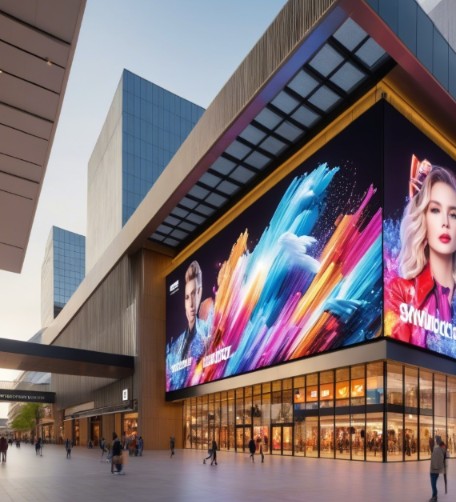
Why Choose an Outdoor LED Screen ?
Outdoor LED screens combine the visibility of large-format signage with the flexibility of digital content. Unlike a printed sign, the same screen can promote different products, campaigns, events and messages throughout the day. Content can include video, animation, images, pricing, promotions, wayfinding information and live or scheduled messages.
For commercial sites where visibility matters, LED technology offers a major advantage: brightness. Purpose-built outdoor LED screens are engineered to remain visible in strong ambient light, while their modular construction allows the display to be scaled from a compact shopfront installation to a large architectural or advertising screen.
Key Benefits
· Outstanding visibility – high-brightness LEDs help content remain vivid in strong daylight.
· Dynamic advertising – update campaigns without replacing printed graphics or physical sign faces.
· Flexible sizing – modular cabinets can be combined into custom widths, heights and aspect ratios.
· Long viewing range – select P2, P3 or P4 to balance image detail, viewing distance and project budget.
· Strong visual impact – motion, colour and changing content attract attention more effectively than static signage.
· Easy servicing – modular LED panels, power supplies and receiving cards can be replaced individually.
· Scalable control – content can be managed locally or through network-connected control solutions, depending on the system selected.
Outdoor LED Screen Features
High Brightness for Outdoor Visibility
Outdoor LED displays typically operate at substantially higher brightness than indoor LED screens. For commercial outdoor applications, project brightness is commonly specified in the 6,000–9,500+ nit range, with higher-output options available for demanding direct-sunlight locations.
Weather-Resistant Cabinet Construction
Outdoor cabinets are designed to resist rain, dust and environmental exposure. Depending on the selected cabinet, IP65 or higher front protection can be specified, with rear protection determined by the service and enclosure design.
High Refresh Rate
A refresh rate of 3,840 Hz or higher is commonly specified for premium commercial LED installations. This produces smoother motion and helps reduce visible scan lines or flicker when the screen is photographed or filmed.
Wide Viewing Angle
Modern SMD outdoor LED technology provides a broad horizontal and vertical viewing angle so content remains readable from multiple approach directions.
Modular & Serviceable
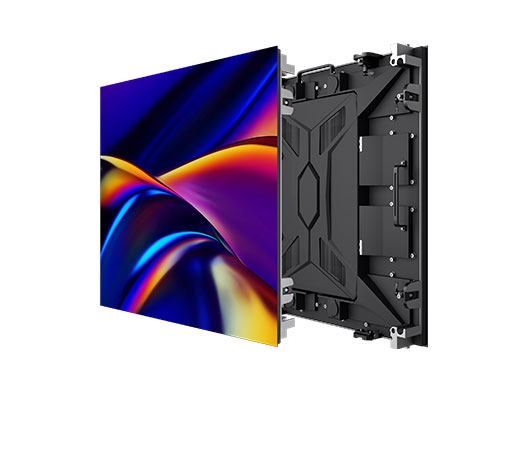
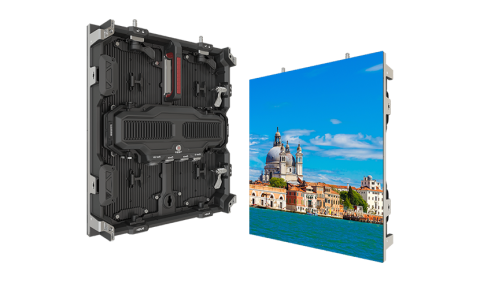
The display is assembled from repeatable LED modules and cabinets. This makes it easier to create custom screen sizes and replace individual service components without replacing the entire display.
Automatic Brightness Control
An optional ambient-light sensor can adjust brightness through the day, improving night-time comfort and reducing unnecessary power consumption when full daytime brightness is not required.
Flexible Content Control
The screen can be paired with a suitable LED controller and media player for scheduled content, network control and remote content updates. Available control options depend on the final system architecture.
P2 vs P3 vs P4 – What Is the Difference?
The “P” number describes pixel pitch: the centre-to-centre distance between adjacent LED pixels, measured in millimetres. A smaller pixel pitch places more pixels into every square metre, producing a higher-resolution image and allowing the audience to view the screen from closer distances.
For the same physical screen size, P2 contains four times as many pixels as P4. That additional pixel density improves text, fine graphics and close-range video, but it also increases the number of LED components and therefore normally increases the system cost.
Option | Pixel Pitch | Pixel Density | Approx. Minimum Viewing Distance* | Best Suited To |
P2 | 2.0 mm | 250,000 pixels/m² | ≈ 2 m | Premium close-view outdoor installations, detailed text, shopfronts, high-resolution architectural screens |
P3 | 3.0 mm | ≈ 111,111 pixels/m² | ≈ 3 m | Versatile commercial signage, shopping centres, façades, medium viewing distances |
P4 | 4.0 mm | 62,500 pixels/m² | ≈ 4 m | Large-format advertising, roadside visibility, higher mounting positions and longer viewing distances |
*Viewing distance is a practical rule-of-thumb only. Final pitch selection should also consider screen size, content, audience movement, viewing angle and budget.
Resolution Example: 4 m × 2 m Screen
Pixel Pitch | Approx. Resolution | Total Pixels | Visual Character |
P2 | 2000 × 1000 | 2.0 million | Very fine detail; suitable for close viewing |
P3 | ≈ 1333 × 667 | ≈ 0.89 million | Strong balance of detail and cost |
P4 | 1000 × 500 | 0.5 million | Excellent for medium-to-long-distance viewing |
Quick guide: choose the smallest pixel pitch that delivers a meaningful visual improvement at the real audience viewing distance. A finer pitch is not automatically better if the screen is viewed from far away. |
Proposed Technical Specification
The table below is a publish-ready technical benchmark for Aurora Display’s P2, P3 and P4 outdoor cabinet range. Exact values should be matched to the final cabinet, LED package, power supply, receiving card and manufacturer datasheet selected for each project.
Parameter | P2 | P3 | P4 | Notes |
LED Technology | Outdoor SMD / 3-in-1 | Outdoor SMD / 3-in-1 | Outdoor SMD / 3-in-1 | Final LED package project-dependent |
Pixel Pitch | 2.0 mm | 3.0 mm | 4.0 mm | Nominal |
Pixel Density | 250,000 px/m² | ≈111,111 px/m² | 62,500 px/m² | Calculated from pitch |
Typical Brightness | 6,000–9,500+ nits | 6,000–9,500+ nits | 6,000–9,500+ nits | Higher brightness available for demanding sites |
Refresh Rate | ≥3,840 Hz | ≥3,840 Hz | ≥3,840 Hz | Premium controller configuration |
Grey Scale | 14–16 bit | 14–16 bit | 14–16 bit | Controller / driver dependent |
Viewing Angle | Approx. 140–160° H | Approx. 140–160° H | Approx. 140–160° H | Vertical angle varies by LED package |
Ingress Protection | IP65 front; rear varies | IP65 front; rear varies | IP65 front; rear varies | IP65/IP66 cabinet options available in the market |
Colour Temperature | Adjustable | Adjustable | Adjustable | Typical commercial range ~3,000–10,000 K |
Typical Max Power | Approx. 550–650 W/m² | Approx. 550–650 W/m² | Approx. 550–650 W/m² | Final power depends on brightness and cabinet |
Typical Average Power | Approx. 200–300 W/m² | Approx. 200–300 W/m² | Approx. 200–300 W/m² | Content and brightness dependent |
Operating Temperature | Typically -20°C to +50°C | Typically -20°C to +50°C | Typically -20°C to +50°C | Confirm final model |
Service Access | Front / Rear options | Front / Rear options | Front / Rear options | Choose to suit site access |
Power Input | Configured for AU 230–240 V AC | Configured for AU 230–240 V AC | Configured for AU 230–240 V AC | Electrical design by licensed electrician |
Cabinet Format | Modular | Modular | Modular | Common formats include 960×960 mm and 500×500/1000 mm |
Cabinet Resolution Example (960×960 mm) | 480 × 480 | 320 × 320 | 240 × 240 | Example only |
Control | Synchronous / media player | Synchronous / media player | Synchronous / media player | Remote/cloud options available depending on controller |
Content & Control Options
The visual performance of an LED screen depends on both the hardware and the content. A correctly configured control system maps the source content to the physical screen resolution and allows scheduled playback of images, videos and promotional material.
· Scheduled playlists for different times of day
· Static images, animated graphics and video
· Full-screen or multi-zone layouts
· Local media player or network-connected control
· Optional remote content management, depending on the selected controller
· Automatic brightness control with optional light sensor
· Screen monitoring and status functions available with compatible control systems
Typical Applications
· Retail shopfronts and shopping centres
· Building façades and commercial developments
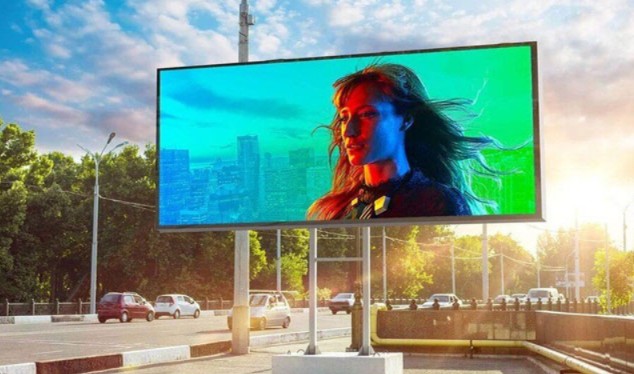
· Roadside and forecourt advertising
· Car dealerships and large-format retail
· Sports venues and stadium applications
· Hospitality venues and entertainment precincts
· Schools, campuses and community facilities
· Transport and public information displays
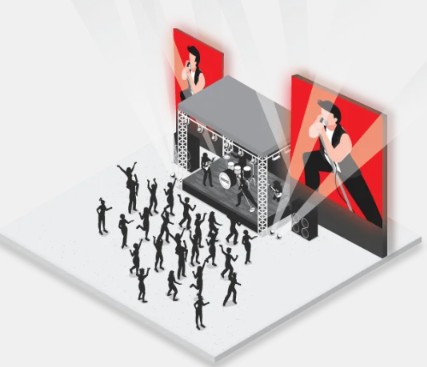
· Event venues and outdoor activation spaces
· Corporate branding and architectural digital signage
Maintenance & Serviceability
Outdoor LED displays are designed to be maintained at component level. A practical service plan should allow technicians to reach LED modules, receiving cards, power supplies and data/power connections without dismantling the entire screen.
· Front-service systems are ideal where the display is mounted close to a wall or there is no rear access.
· Rear-service systems provide direct access from behind the display where a maintenance corridor or cabinet depth is available.
· Keeping spare LED modules from the same production batch can help maintain colour consistency during future repairs.
· Routine inspection should include cabinet seals, drainage, connectors, fans or ventilation paths (where fitted), power distribution and structural fixings.
· Brightness and colour calibration can be reviewed periodically for high-profile installations.
Built for Bright Outdoor Environments
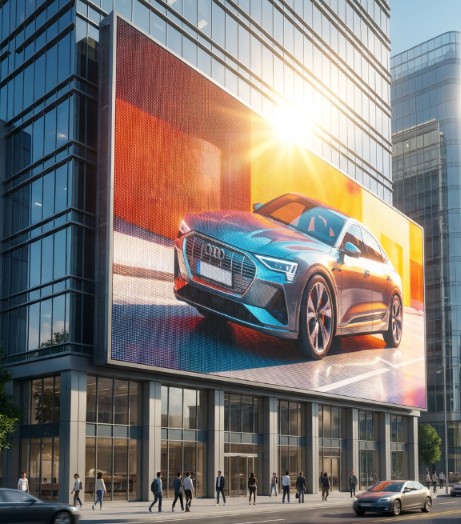
Outdoor LED screens are designed for environments where standard indoor displays can struggle. High-output LEDs and a high-contrast black mask help maintain legibility and colour impact in strong daylight. For sites exposed to direct sun, screen orientation, ambient brightness, viewing angle and local shading conditions should be reviewed during specification.
Brightness can also be managed dynamically. During the day, the screen can run at a higher output; at night, brightness can be reduced for comfortable viewing and lower power consumption. Where required, an ambient-light sensor can automate this process.
Modular Cabinet Design
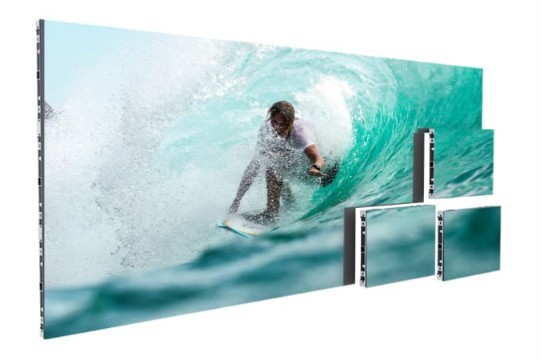
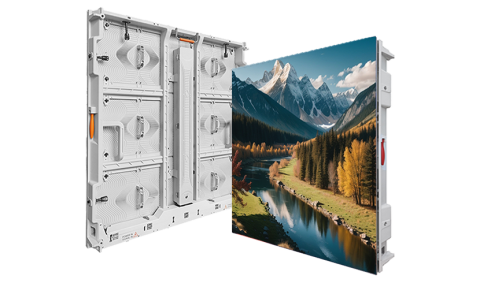
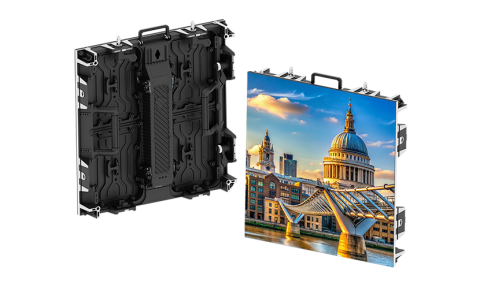
An outdoor LED video wall is not manufactured as one giant panel. It is built from repeatable LED cabinets, and each cabinet contains smaller LED modules. This modular architecture gives the system three major advantages: flexible size, practical installation and straightforward maintenance.
· Custom screen size – combine cabinets to create the required width and height.
· Serviceable modules – replace individual LED modules instead of an entire screen.
· Replaceable electronics – power supplies, receiving cards and related components can be serviced independently.
· Future flexibility – subject to cabinet compatibility and structural design, systems can be expanded or reconfigured.
· Cleaner installation – cabinet alignment systems help create a consistent, seamless LED surface.
Installation Methods
The correct mounting method depends on the building structure, access requirements, screen size, wind exposure, maintenance strategy and planning constraints. Aurora Display can design the LED cabinet layout around the available space and coordinate the display with the supporting structure and electrical/data requirements.
Wall / Façade Mounted
A steel support frame is fixed to the building or structural substrate, with LED cabinets mounted to the frame. This is common for shopfronts, commercial buildings and exterior walls. Front-service cabinets are useful where rear access is limited.
Freestanding Structure
The LED screen is installed on an engineered steel frame independent of the building. This arrangement is suitable for forecourts, shopping centres, entrances and advertising structures.
Pole or Pylon Mounted
A single- or double-sided LED display can be supported on a pole or pylon structure for long-distance visibility. Structural design must account for the screen area, cabinet weight and site wind loads.
Rooftop / Elevated Installation
Large outdoor LED screens can be mounted above a roofline or at elevated positions where long-range visibility is required. Access, structural loading and maintenance planning are particularly important.
Recessed or Integrated Architectural Installation
The cabinet system can be integrated into a façade opening, signage enclosure or custom architectural feature for a clean built-in appearance.
Typical Installation Process
1. Site assessment – confirm viewing direction, dimensions, access, sunlight exposure and intended content.
2. Pixel pitch and screen size selection – choose P2, P3 or P4 based on viewing distance, image detail and budget.
3. Structural design – determine the supporting frame, mounting points and site-specific structural requirements.
4. Electrical and data planning – confirm power distribution, isolators, cabling, controller location and network connection.
5. Cabinet installation – install and align the LED cabinets on the completed support structure.
6. Control system setup – configure the sending/receiving system, resolution mapping and content player.
7. Calibration and testing – check brightness, colour uniformity, module alignment, redundancy and content playback.
8. Handover – provide operating guidance and confirm maintenance access and spare-part strategy.
Important: final structural, electrical and access requirements are site-specific. Permanent outdoor installations should be coordinated with appropriately qualified trades and any approvals required for the project. |
Frequently Asked Questions
What is the best pixel pitch for an outdoor LED screen?
It depends mainly on viewing distance and required image detail. P2 is ideal for closer viewing, P3 is a versatile mid-range option, and P4 is highly cost-effective for larger screens and longer viewing distances.
What does P2, P3 or P4 mean?
It is the pixel pitch in millimetres. P2 has 2 mm between pixels, P3 has 3 mm and P4 has 4 mm. A smaller number means higher pixel density and finer detail.
Can an outdoor LED screen be viewed in direct sunlight?
Yes, provided the display is correctly specified for the site. Outdoor LED screens use much higher brightness than typical indoor displays, commonly around 6,000–9,500+ nits for commercial applications.
Is the screen waterproof?
Outdoor LED cabinets are designed for weather exposure. IP65 or higher front protection is common in commercial outdoor products. The exact front and rear IP rating depends on the selected cabinet and should be confirmed in the final specification.
Can I choose any screen size?
LED screens are modular, so many custom sizes are possible. The final dimensions should be based on cabinet/module increments, structural requirements and the aspect ratio of the content.
Do I need rear access for maintenance?
Not necessarily. Front-service cabinet options allow LED modules and service components to be accessed from the front, which is useful for wall-mounted installations.
Can the brightness change automatically between day and night?
Yes. Compatible control systems can use scheduled brightness settings or an ambient-light sensor to reduce brightness at night and increase it during bright daytime conditions.
Can the content be updated remotely?
Yes, depending on the controller and media player selected. Network, Wi-Fi, 4G and cloud-managed options can be incorporated into the project where required.
What type of content can I display?
Typical content includes video, motion graphics, advertising campaigns, product images, text, pricing, announcements, wayfinding and scheduled promotional messages.
How long does installation take?
The installation period depends on screen size, structural work, access equipment, electrical works and site conditions. Smaller shopfront projects may be completed quickly once the supporting structure and services are ready; large façade or freestanding projects require more planning and coordination.
Can Aurora Display help with installation?
Yes. Aurora Display can assist with screen configuration, cabinet layout, installation planning, control setup and coordination of the complete display solution for commercial projects.
Final Call to Action
Need Help Choosing P2, P3 or P4?
Every outdoor LED project is different. The right solution depends on screen size, viewing distance, installation height, sunlight exposure, content and budget.
Send Aurora Display your approximate screen dimensions, installation photos or drawings and the typical viewing distance. We can recommend a suitable pixel pitch and prepare a project-specific outdoor LED screen solution.
REQUEST A QUOTE | DISCUSS YOUR PROJECT | SEND US YOUR SCREEN SIZE |
Our Clients